Keep the Tree. Cabling, Bracing & Tree Health Care.
A big old tree with a weak union does not have to become a stump. Cabling, bracing and a pruning plan can carry an heirloom tree for decades. This is the work that separates an arborist from a removal service.
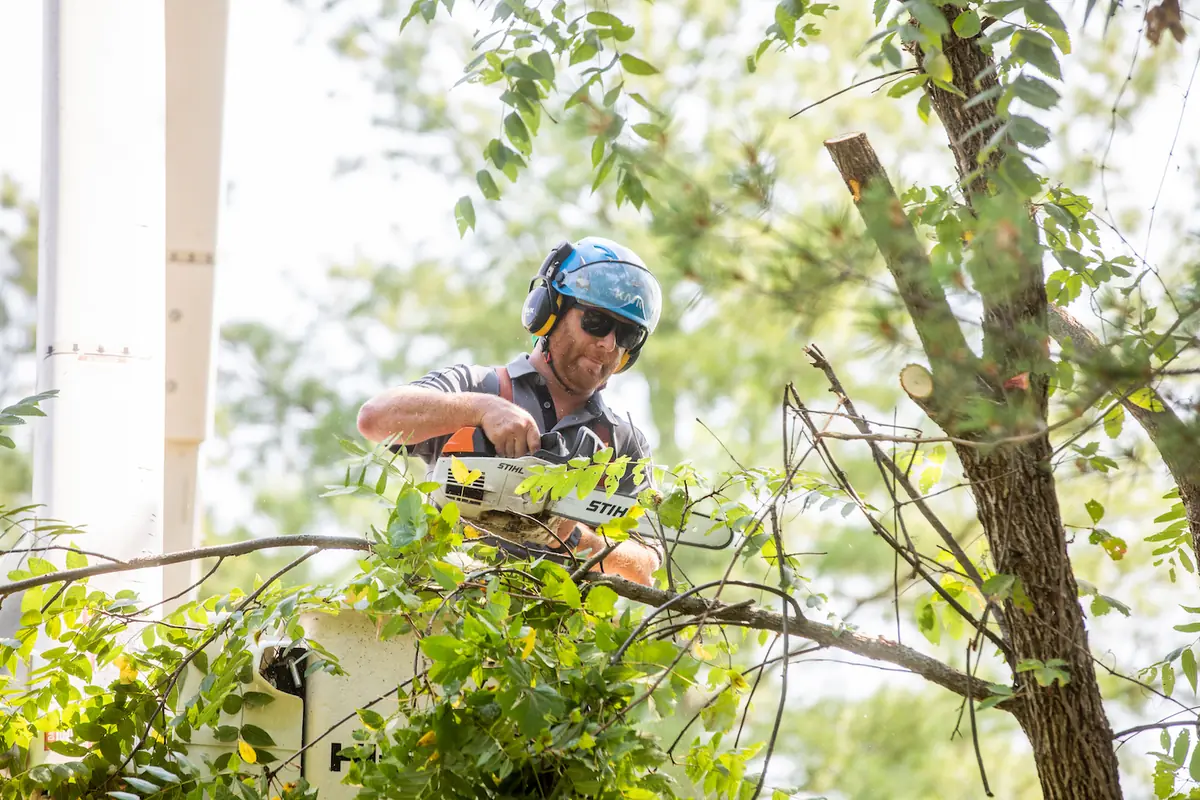
Sylvan Scapes provides tree preservation across Staunton, Charlottesville and Albemarle County, VA: cabling and bracing for weak unions, ANSI A300 structural pruning, tree risk assessment, disease and pest diagnosis, and ongoing plant health care plans. Assessments are performed by an ISA Certified Arborist. Call 540-885-2199.
Support for the tree you do not want to lose
Large trees often develop a structural weakness long before they become dangerous: a codominant stem with included bark, a heavy horizontal limb, a crack in a union carrying half the canopy. Left alone those fail, usually in a storm, usually onto whatever is underneath.
A cable installed high in the canopy redistributes that load between stems. A brace rod does the same thing through a weak union directly. Neither is visible from the ground once installed, and both buy the kind of time measured in decades.
Cabling is not a fix for a tree that is already failing. It is a way to protect a sound tree with one known weakness, which is why the assessment comes first.
What preservation covers
- Static and dynamic cabling
- Through-union brace rods
- Crown cleaning
- Crown reduction
- Deadwood removal
- Roof and drive clearance
- Tree risk assessment
- Disease & pest diagnosis
- Soil and root zone work
- Scheduled care plans
Pruning that heals
Where the cut is made determines whether the tree seals it or rots from it. Cuts made at the branch collar close over. Cuts made flush or left as stubs do not, and they open a path for decay straight into the trunk.
Topping, still done by plenty of companies, is the worst of it. A topped tree throws weak regrowth from the wound, and in ten years you have a taller, heavier, more dangerous tree than the one you started with.
Our pruning follows ANSI A300: crown cleaning, crown reduction done with proper reduction cuts, deadwood removal, and clearance work over roofs and drives.
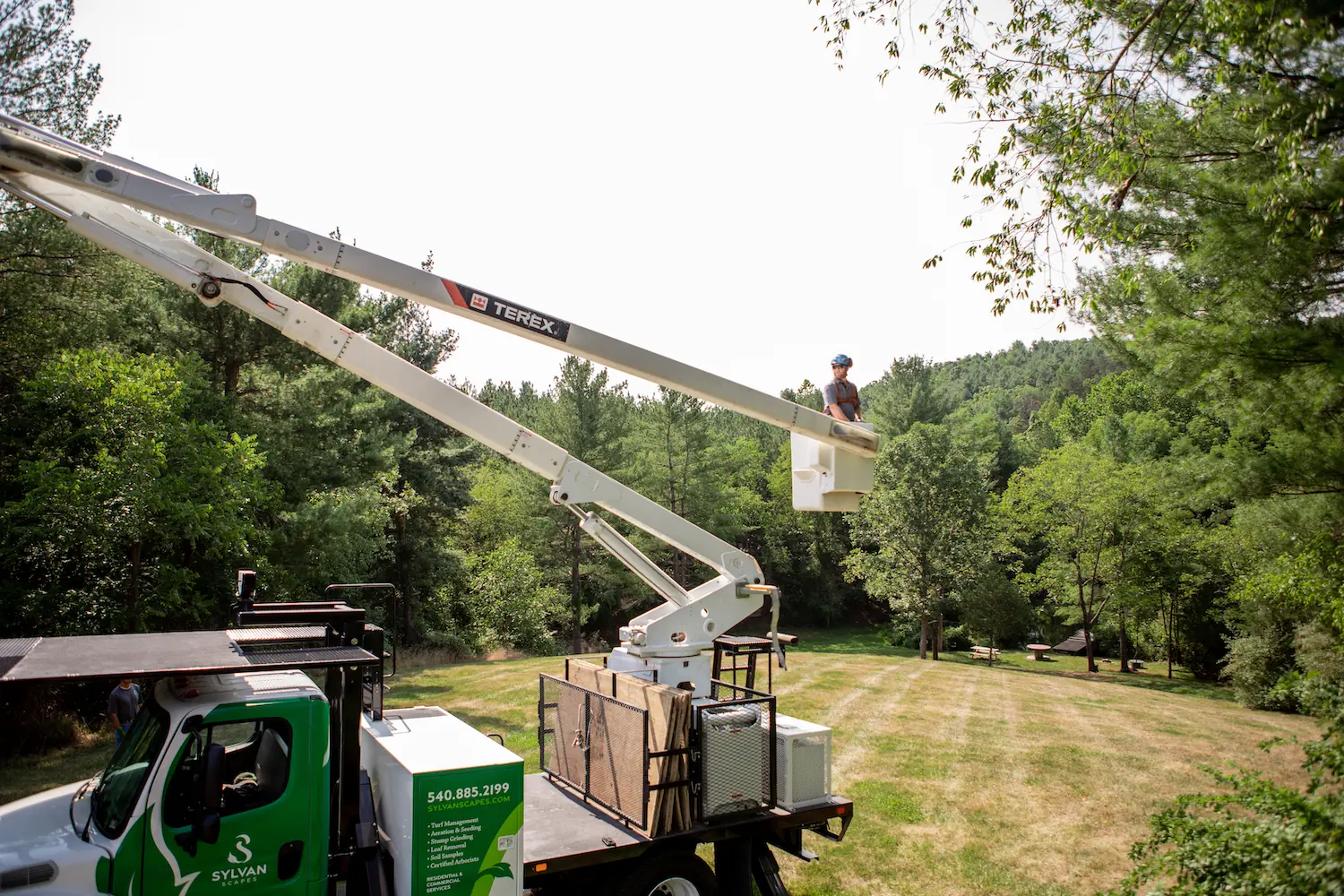
Diagnosis before treatment
A tree dropping leaves in July has a reason. Finding the reason is the job, and it is usually not what the internet told you.
Tree risk assessment
Systematic evaluation of structure, defects and what is underneath. The report tells you which trees need work, which need watching, and which are fine.
Request an assessmentDisease & pest identification
Fungal infection, borers, scale, root damage from construction or a grade change. Correct identification first, then a treatment that matches it.
Request an assessmentOngoing health care
Scheduled inspection, soil and root zone work, and pruning on a cycle. For properties where the trees are part of what the place is worth.
Request an assessmentMature hardwoods are worth protecting
Properties across the Valley and Albemarle County carry white oaks, sugar maples and tulip poplars that predate the houses next to them. Those trees are not replaceable on any timeline that matters to the person who owns them. A tree planted today is a sapling for the next owner and a shade tree for the one after that.
Preservation costs a fraction of removal plus replanting, and it keeps something that cannot be bought back. When a tree genuinely has to come down we will say so directly. But that call should be made by someone qualified to assess the tree, not by whoever is quoting the removal.
- Certification
- ISA Certified Arborist, International Society of Arboriculture
- Accreditation
- Tree Care Safety Professional (CTSP), Tree Care Industry Association
- Safety standard
- Work performed within ANSI Z133.1 arboriculture safety requirements
- Pruning standard
- ANSI A300 pruning specifications
- Operating since
- 2003, Staunton, Virginia
- Service area
- Augusta, Albemarle and Rockingham Counties
Not sure whether the tree can be saved?
An arborist assessment answers that before anyone quotes a removal.
Tree preservation questions
What homeowners ask before deciding whether a tree comes down.
Call 540-885-2199